iUjex | Making Shipping Effortless: Reducing 8 Steps to 5
Year
2024-2025
2024-2025
2024-2025
2024-2025
Services
UI/UX Design
UI/UX Design
UI/UX Design
UI/UX Design
Team
CEO, Software Engineers
CEO, Software Engineers
CEO, Software Engineers
CEO, Software Engineers
Project Type
Shipping platform
Shipping platform
Shipping platform
Shipping platform
About The Company
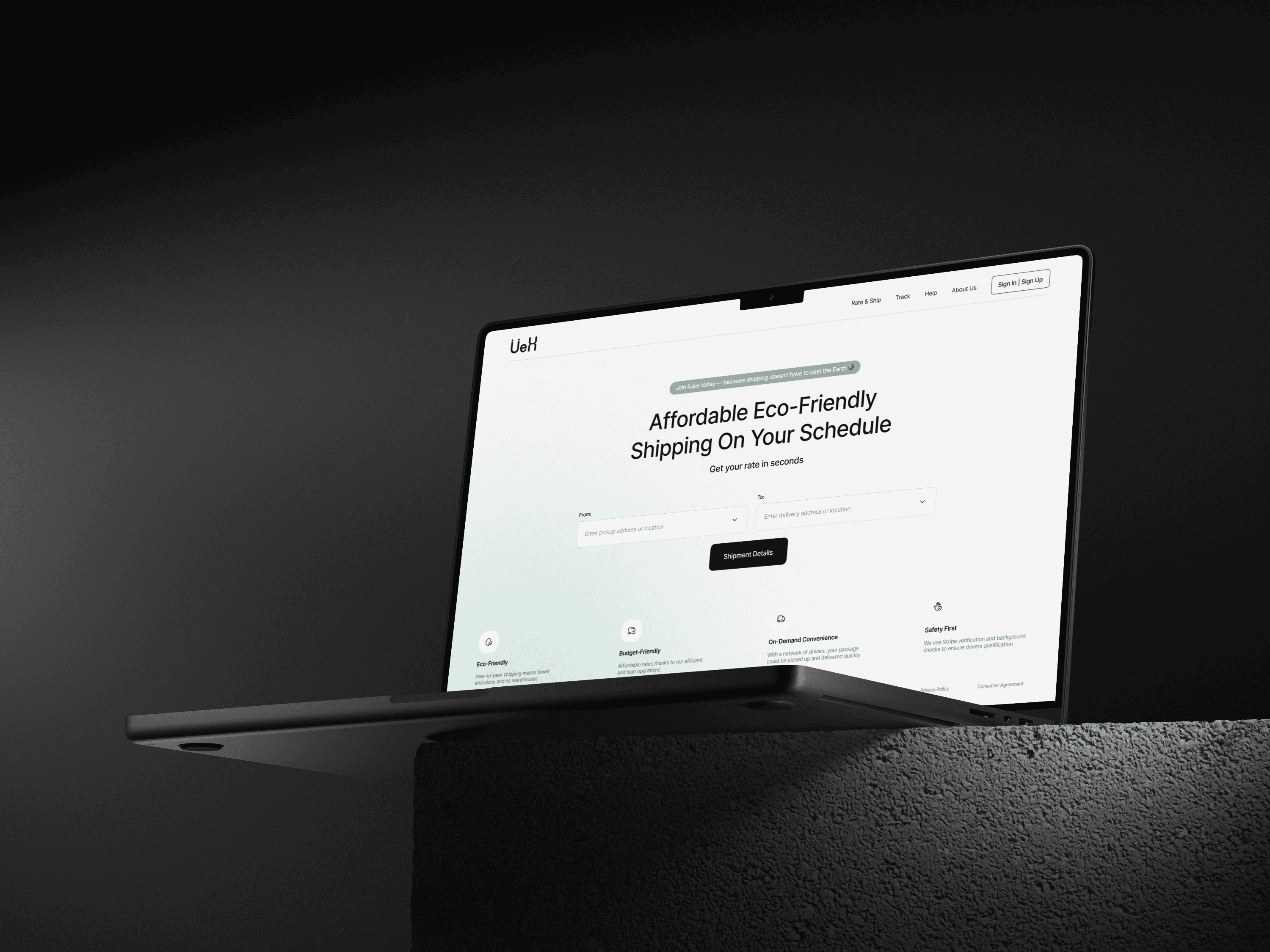
iUjex serves a growing market of small business owners, independent online sellers, and individual shippers who need affordable and efficient logistics solutions. The company’s mission is simple: turn complex shipping operations into a seamless, transparent experience that anyone can manage. Location: California, USA Founded: 2020
Website
Project Overview
iUjex is a B2B and B2C shipping platform designed to make deliveries effortless for small businesses and individual sellers. It provides instant rate calculation, shipment creation, and real-time package tracking: all within a clean and accessible interface. • Role: Product Designer (end-to-end design) • Duration: 6 months • Team: Founder, Software Engineer (Backend), Software Engineer (Frontend) • Tools: Figma, FigJam, Miro
iUjex is a B2B and B2C shipping platform designed to make deliveries effortless for small businesses and individual sellers. It provides instant rate calculation, shipment creation, and real-time package tracking: all within a clean and accessible interface. • Role: Product Designer (end-to-end design) • Duration: 6 months • Team: Founder, Software Engineer (Backend), Software Engineer (Frontend) • Tools: Figma, FigJam, Miro
iUjex is a B2B and B2C shipping platform designed to make deliveries effortless for small businesses and individual sellers. It provides instant rate calculation, shipment creation, and real-time package tracking: all within a clean and accessible interface. • Role: Product Designer (end-to-end design) • Duration: 6 months • Team: Founder, Software Engineer (Backend), Software Engineer (Frontend) • Tools: Figma, FigJam, Miro
iUjex is a B2B and B2C shipping platform designed to make deliveries effortless for small businesses and individual sellers. It provides instant rate calculation, shipment creation, and real-time package tracking: all within a clean and accessible interface. • Role: Product Designer (end-to-end design) • Duration: 6 months • Team: Founder, Software Engineer (Backend), Software Engineer (Frontend) • Tools: Figma, FigJam, Miro
Problem Statement & Goals
Existing shipping tools often overwhelm users with unnecessary steps, unclear pricing, and inconsistent interfaces. As a result, users abandon tasks or rely on costly third-party solutions. Project Goals: • Reduce friction in shipment creation and rate calculation • Clarify calls-to-action for every stage of the journey • Ensure fully responsive and accessible design for desktop, tablet, and mobile • Create a fast, transparent, and user-friendly shipping flow for first-time and returning users
My Contribution
My Contribution
As the Product Designer for iUjex, I collaborated closely with the CEO and development team to design and improve the shipping platform from concept to implementation. My responsibilities included user flow design, wireframing, high-fidelity UI design, interactive prototyping, and the creation of a scalable design system. Throughout the project, I worked with stakeholders to translate business goals and operational requirements into intuitive user experiences. I helped evaluate design trade-offs, align user needs with technical constraints, and refine features through ongoing feedback and iteration. My goal was to simplify complex shipping workflows, making it easy for customers to obtain rates, book deliveries, and track shipments with confidence.
As the Product Designer for iUjex, I collaborated closely with the CEO and development team to design and improve the shipping platform from concept to implementation. My responsibilities included user flow design, wireframing, high-fidelity UI design, interactive prototyping, and the creation of a scalable design system. Throughout the project, I worked with stakeholders to translate business goals and operational requirements into intuitive user experiences. I helped evaluate design trade-offs, align user needs with technical constraints, and refine features through ongoing feedback and iteration. My goal was to simplify complex shipping workflows, making it easy for customers to obtain rates, book deliveries, and track shipments with confidence.
Before vs After
Before vs After
Before 🔻 Multiple disconnected steps without clear guidance 🔻 Confusing pricing estimates and inconsistent feedback 🔻 Poor mobile experience due to non-responsive layouts 🔻 High drop-off rates during shipment creation After ❇️ Guided, step-by-step flow from quote to tracking ❇️ Real-time feedback with transparent cost breakdowns ❇️ Unified responsive design that works seamlessly across devices ❇️ Reduced friction, leading to faster task completion and improved confidence
Before 🔻 Multiple disconnected steps without clear guidance 🔻 Confusing pricing estimates and inconsistent feedback 🔻 Poor mobile experience due to non-responsive layouts 🔻 High drop-off rates during shipment creation After ❇️ Guided, step-by-step flow from quote to tracking ❇️ Real-time feedback with transparent cost breakdowns ❇️ Unified responsive design that works seamlessly across devices ❇️ Reduced friction, leading to faster task completion and improved confidence
Before 🔻 Multiple disconnected steps without clear guidance 🔻 Confusing pricing estimates and inconsistent feedback 🔻 Poor mobile experience due to non-responsive layouts 🔻 High drop-off rates during shipment creation After ❇️ Guided, step-by-step flow from quote to tracking ❇️ Real-time feedback with transparent cost breakdowns ❇️ Unified responsive design that works seamlessly across devices ❇️ Reduced friction, leading to faster task completion and improved confidence
Before 🔻 Multiple disconnected steps without clear guidance 🔻 Confusing pricing estimates and inconsistent feedback 🔻 Poor mobile experience due to non-responsive layouts 🔻 High drop-off rates during shipment creation After ❇️ Guided, step-by-step flow from quote to tracking ❇️ Real-time feedback with transparent cost breakdowns ❇️ Unified responsive design that works seamlessly across devices ❇️ Reduced friction, leading to faster task completion and improved confidence
First Screen: Improved visual clarity and stronger brand identity
Order User Flow: Reduced steps and cognitive load
Research & Insights
Research & Insights
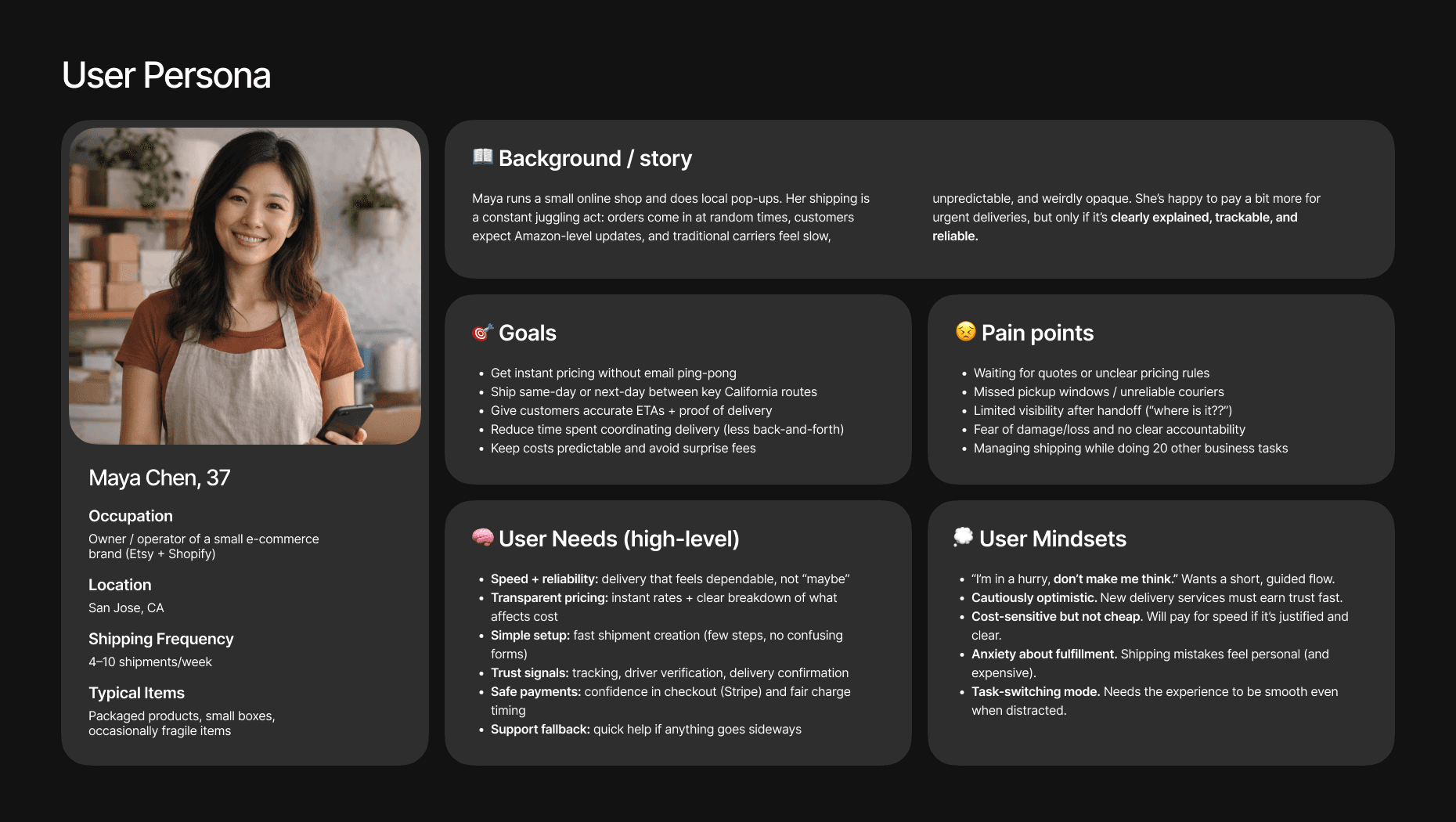
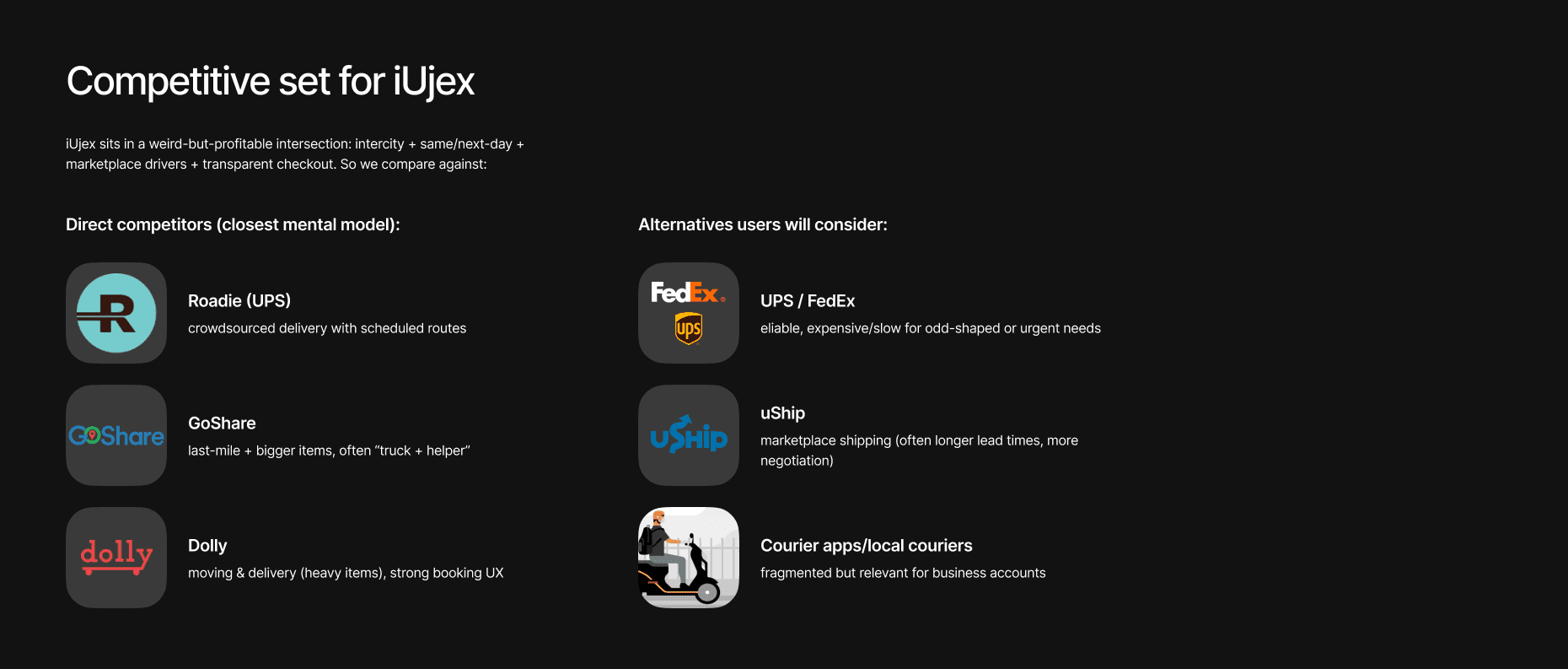
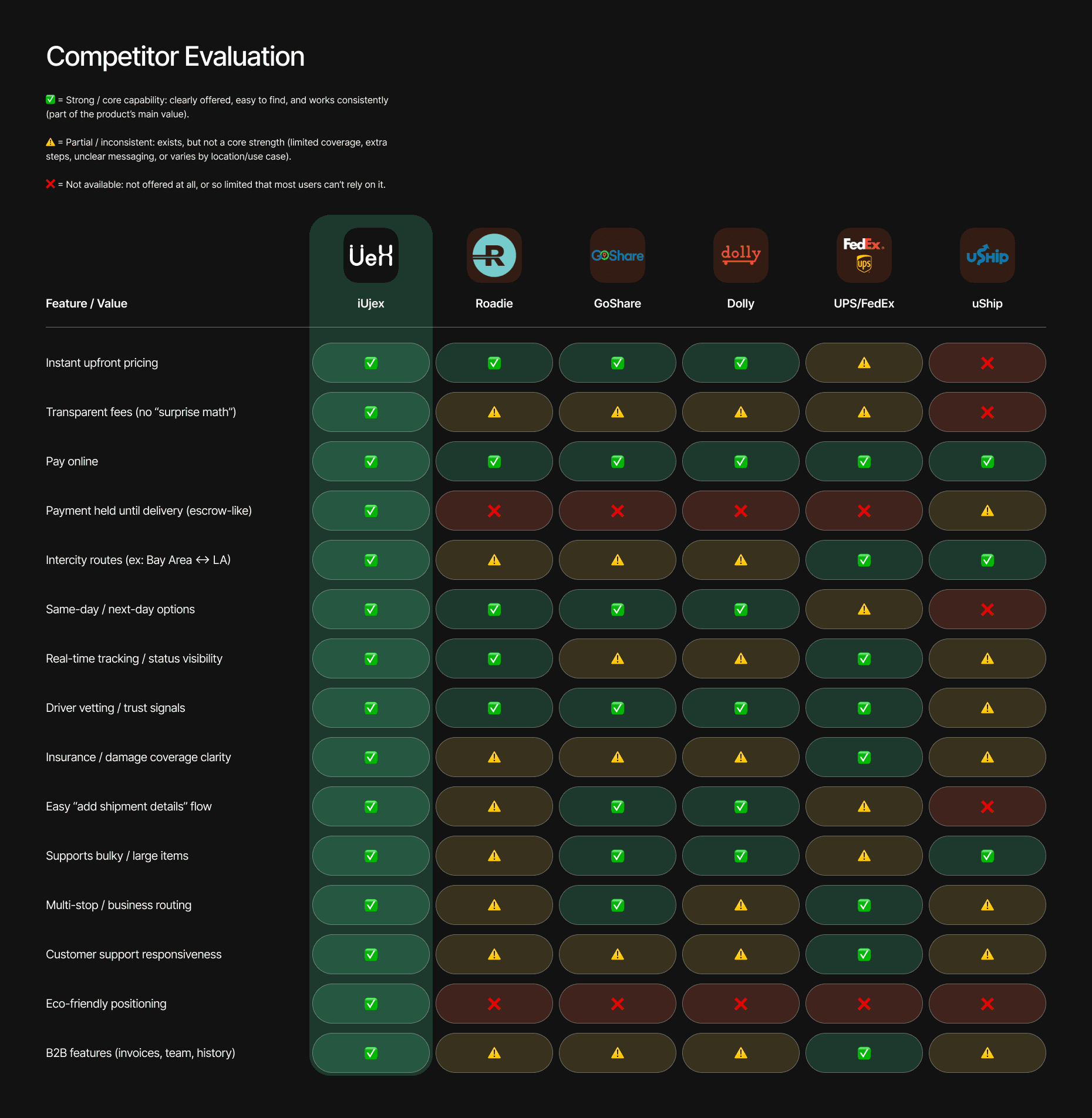
To identify the pain points and opportunities, I conducted: • 5 user interviews with small business owners and independent sellers • Competitive analysis of four leading shipping platforms • Journey mapping to visualize pain points and redundancies
To identify the pain points and opportunities, I conducted: • 5 user interviews with small business owners and independent sellers • Competitive analysis of four leading shipping platforms • Journey mapping to visualize pain points and redundancies
To identify the pain points and opportunities, I conducted: • 5 user interviews with small business owners and independent sellers • Competitive analysis of four leading shipping platforms • Journey mapping to visualize pain points and redundancies
To identify the pain points and opportunities, I conducted: • 5 user interviews with small business owners and independent sellers • Competitive analysis of four leading shipping platforms • Journey mapping to visualize pain points and redundancies

Design Approach
Design Approach
The design strategy focused on clarity, speed, and universal accessibility. Key decisions included: • Streamlined flows for instant quotes, shipment creation, and tracking • Consistent, visible CTAs that guide users through each step • Responsive layouts designed to scale seamlessly across devices • Compliance with WCAG standards for inclusivity I started with low-fidelity wireframes and prototypes, iterated based on user feedback, and moved to high-fidelity mockups for final delivery.
The design strategy focused on clarity, speed, and universal accessibility. Key decisions included: • Streamlined flows for instant quotes, shipment creation, and tracking • Consistent, visible CTAs that guide users through each step • Responsive layouts designed to scale seamlessly across devices • Compliance with WCAG standards for inclusivity I started with low-fidelity wireframes and prototypes, iterated based on user feedback, and moved to high-fidelity mockups for final delivery.
The design strategy focused on clarity, speed, and universal accessibility. Key decisions included: • Streamlined flows for instant quotes, shipment creation, and tracking • Consistent, visible CTAs that guide users through each step • Responsive layouts designed to scale seamlessly across devices • Compliance with WCAG standards for inclusivity I started with low-fidelity wireframes and prototypes, iterated based on user feedback, and moved to high-fidelity mockups for final delivery.
The design strategy focused on clarity, speed, and universal accessibility. Key decisions included: • Streamlined flows for instant quotes, shipment creation, and tracking • Consistent, visible CTAs that guide users through each step • Responsive layouts designed to scale seamlessly across devices • Compliance with WCAG standards for inclusivity I started with low-fidelity wireframes and prototypes, iterated based on user feedback, and moved to high-fidelity mockups for final delivery.
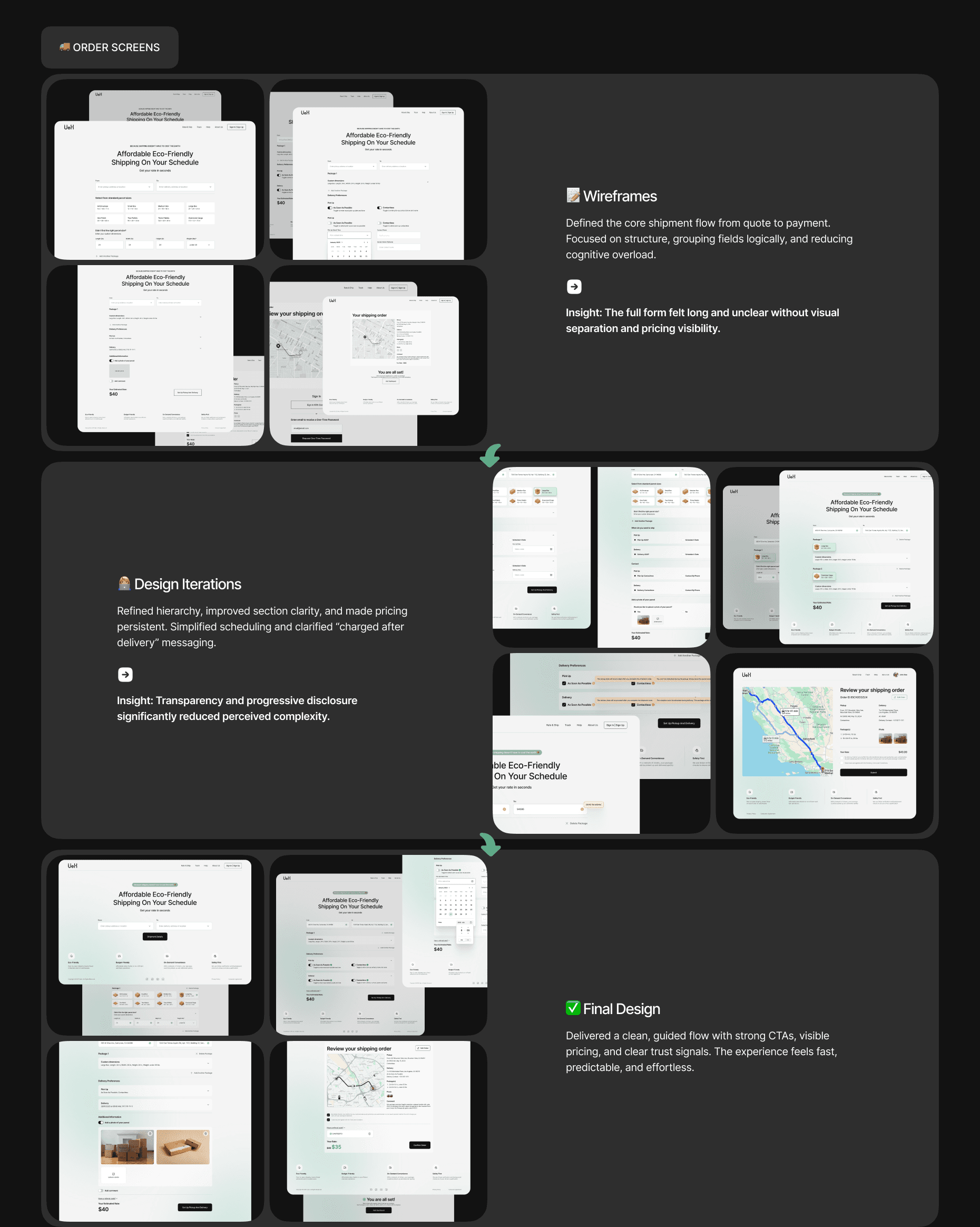
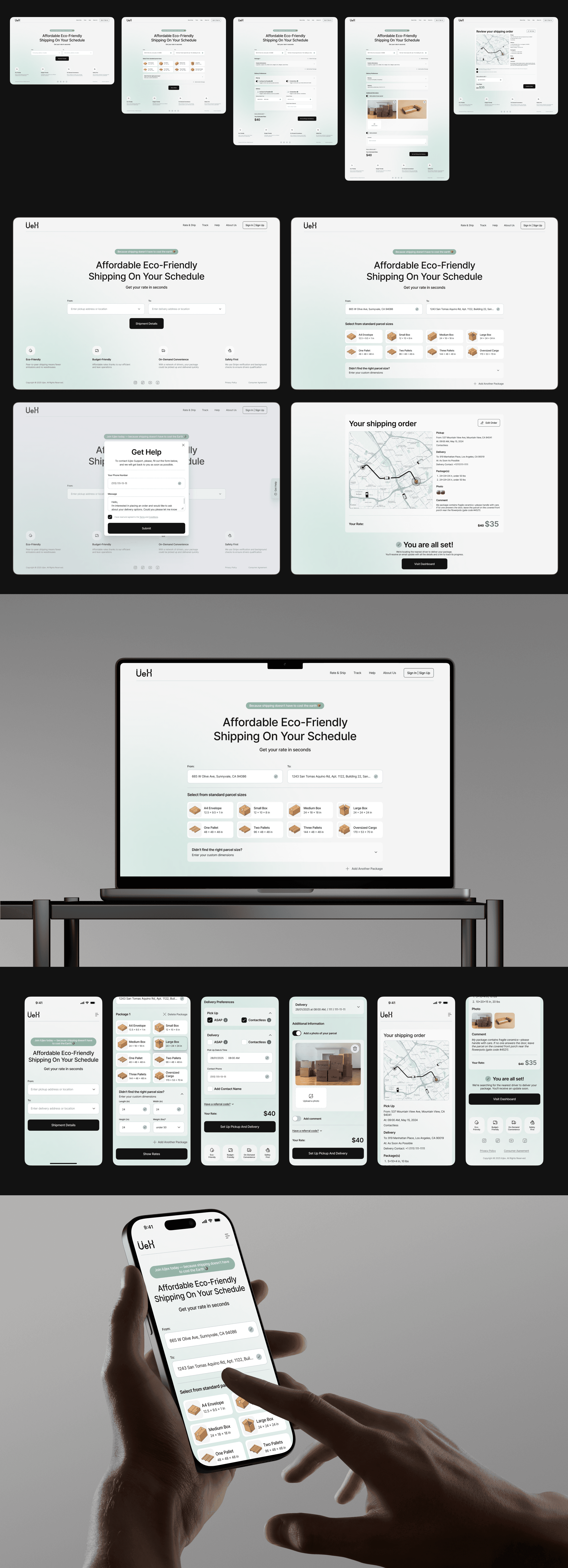
Order User Flow: Reduced steps and cognitive load
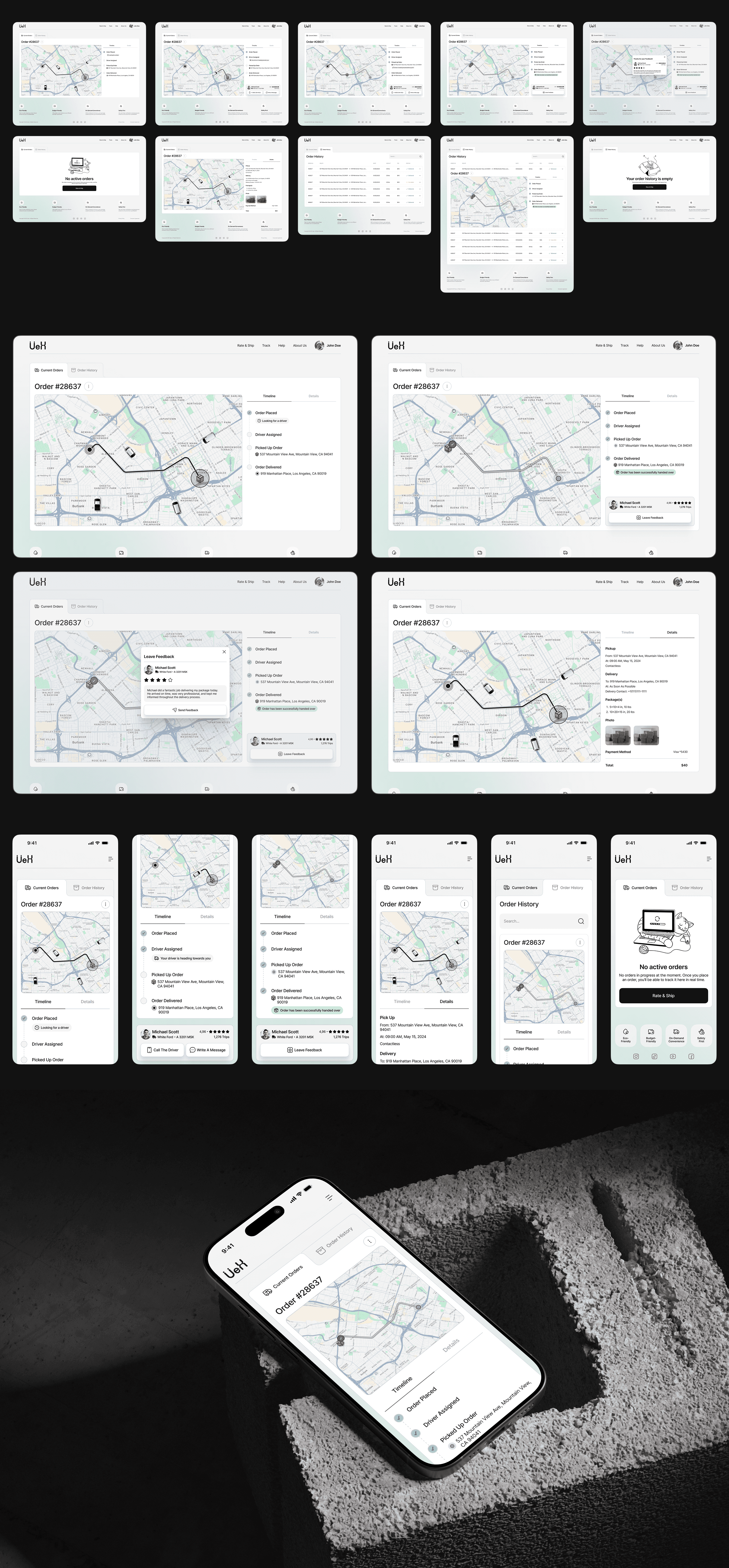
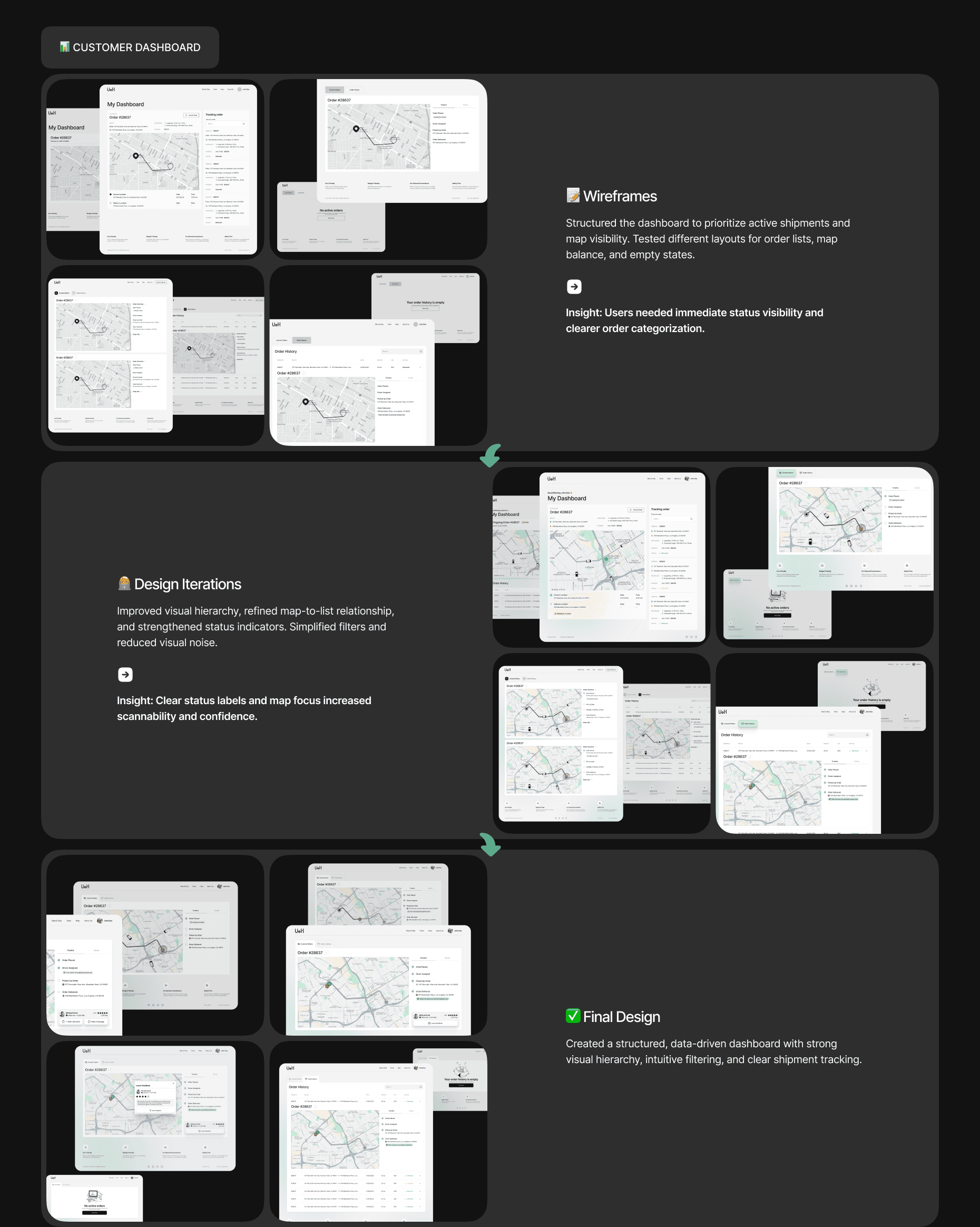
Dashboard: Tracking current and past orders
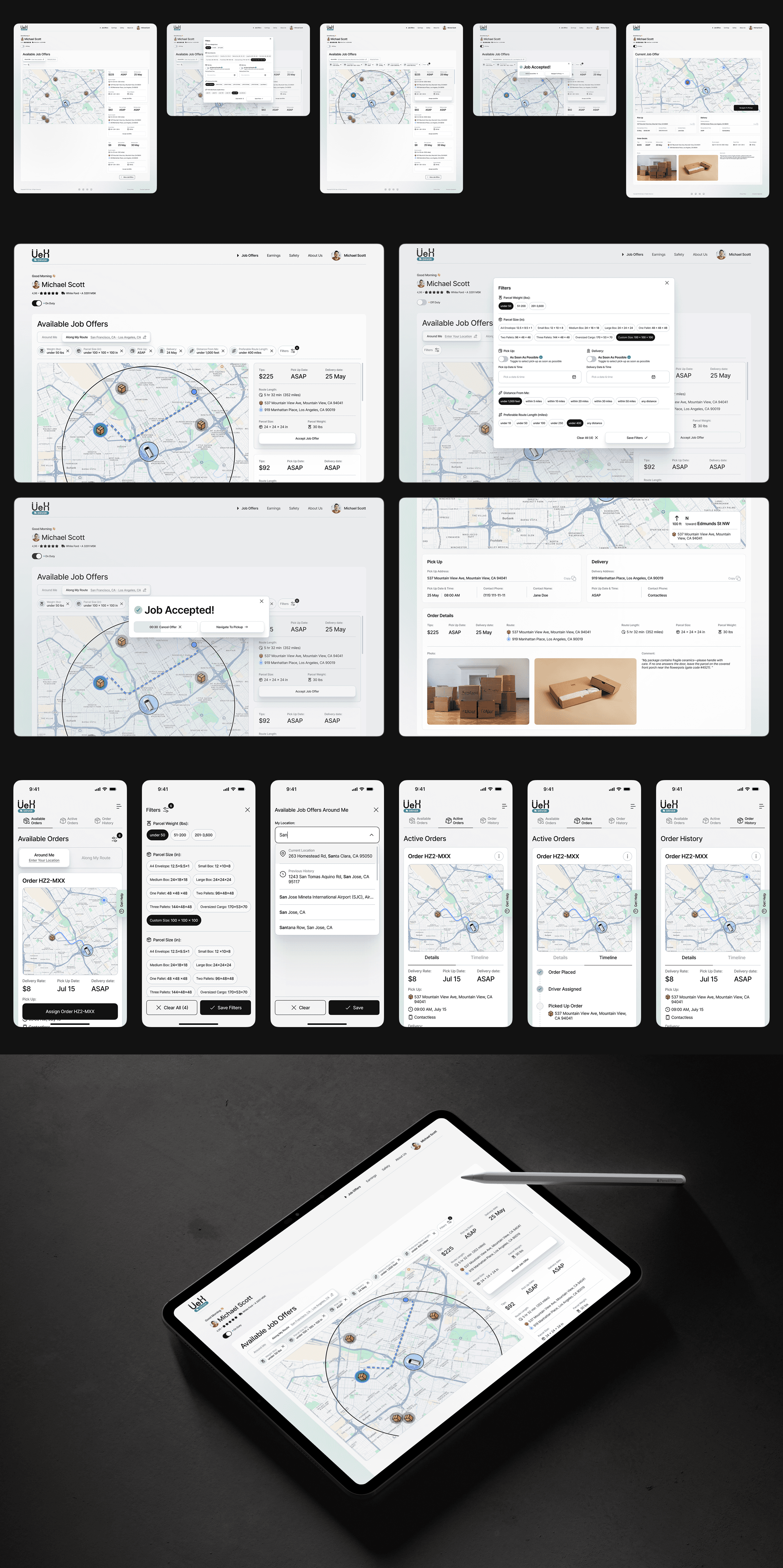
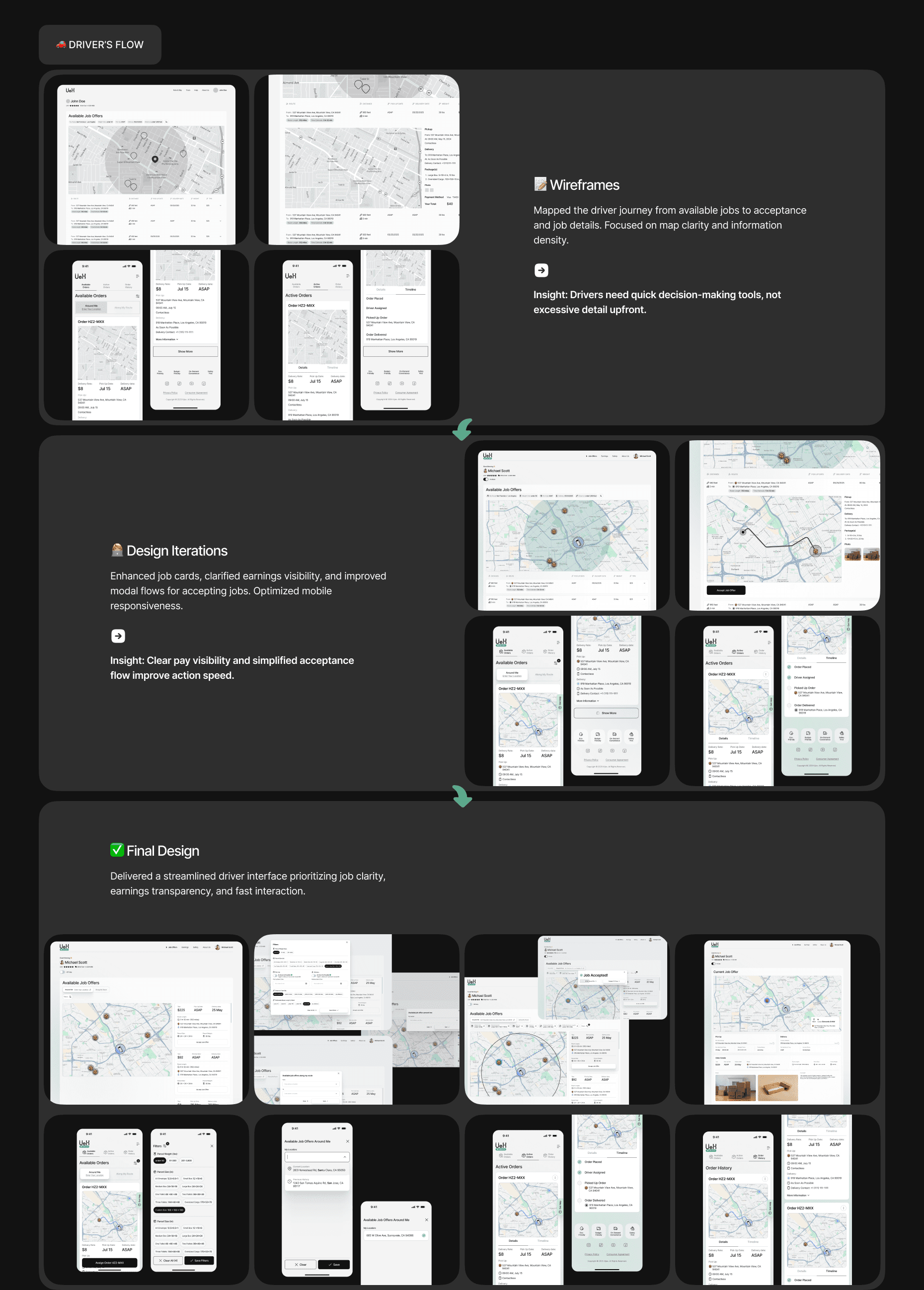
Driver’s Account: Search for available orders
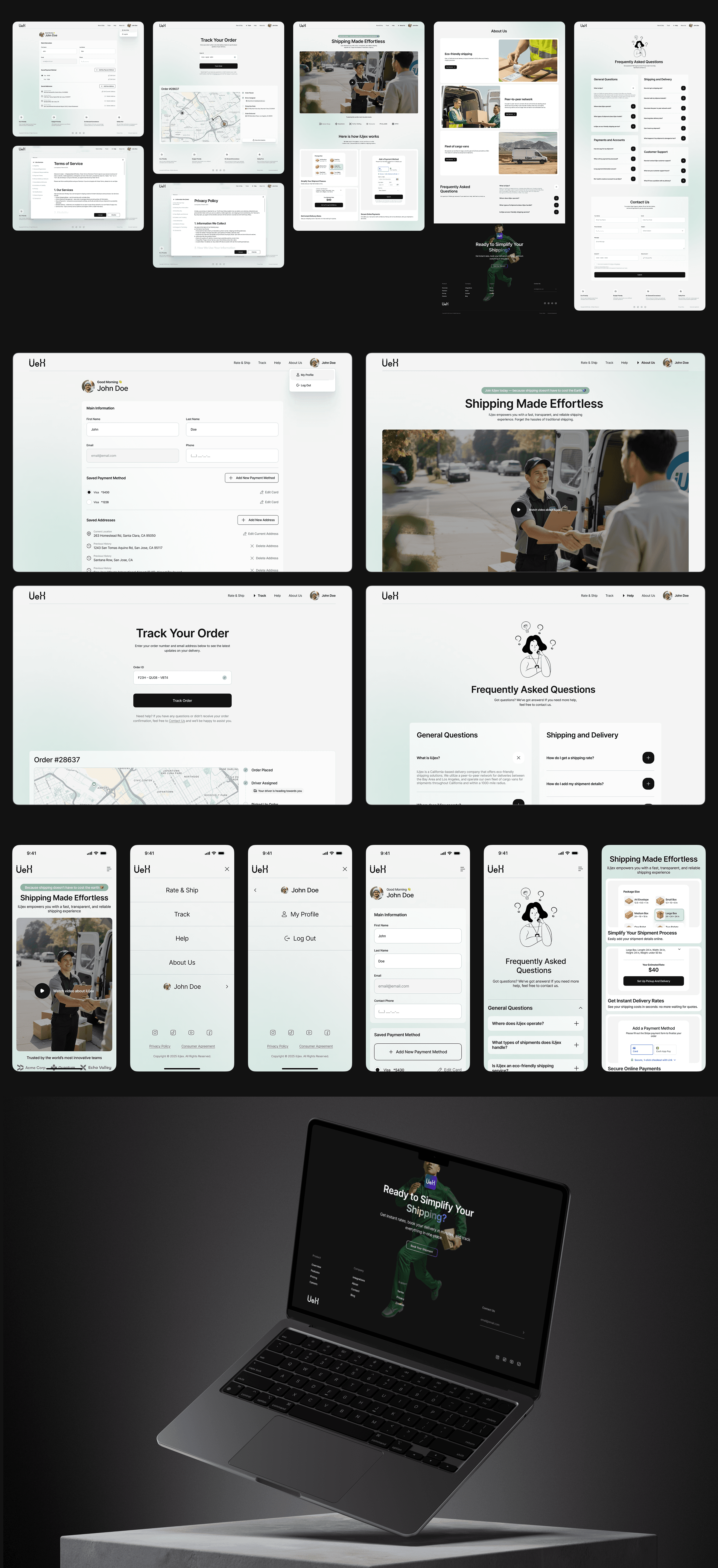
Web Pages: Track order, FAQ, About iUjex, Personal account
Key Learnings & Impact
▸ I learned to design for efficiency and speed, prioritizing usability over aesthetics when it matters most. ▸ I deepened my ability to simplify complex user flows (shipping, rates, tracking) into clear, intuitive interactions. ▸ I practiced designing with a scalable mindset: ensuring that the platform can grow without sacrificing clarity. ▸ I strengthened my collaboration skills by structuring files and flows that are easy to understand and hand off to developers.
▸ I learned to design for efficiency and speed, prioritizing usability over aesthetics when it matters most. ▸ I deepened my ability to simplify complex user flows (shipping, rates, tracking) into clear, intuitive interactions. ▸ I practiced designing with a scalable mindset: ensuring that the platform can grow without sacrificing clarity. ▸ I strengthened my collaboration skills by structuring files and flows that are easy to understand and hand off to developers.
▸ I learned to design for efficiency and speed, prioritizing usability over aesthetics when it matters most. ▸ I deepened my ability to simplify complex user flows (shipping, rates, tracking) into clear, intuitive interactions. ▸ I practiced designing with a scalable mindset: ensuring that the platform can grow without sacrificing clarity. ▸ I strengthened my collaboration skills by structuring files and flows that are easy to understand and hand off to developers.
▸ I learned to design for efficiency and speed, prioritizing usability over aesthetics when it matters most. ▸ I deepened my ability to simplify complex user flows (shipping, rates, tracking) into clear, intuitive interactions. ▸ I practiced designing with a scalable mindset: ensuring that the platform can grow without sacrificing clarity. ▸ I strengthened my collaboration skills by structuring files and flows that are easy to understand and hand off to developers.
Conclusion
Conclusion
Designing iUjex was an opportunity to transform a complex logistics task into a simple, user-centered experience. While the visual UI was intentionally minimal to support functionality over decoration, the UX strategy focused on clarity, speed, and ease of use. This project reinforced the principle that design should make technology feel invisible, removing friction so users can focus on what matters.
Designing iUjex was an opportunity to transform a complex logistics task into a simple, user-centered experience. While the visual UI was intentionally minimal to support functionality over decoration, the UX strategy focused on clarity, speed, and ease of use. This project reinforced the principle that design should make technology feel invisible, removing friction so users can focus on what matters.
Designing iUjex was an opportunity to transform a complex logistics task into a simple, user-centered experience. While the visual UI was intentionally minimal to support functionality over decoration, the UX strategy focused on clarity, speed, and ease of use. This project reinforced the principle that design should make technology feel invisible, removing friction so users can focus on what matters.
Designing iUjex was an opportunity to transform a complex logistics task into a simple, user-centered experience. While the visual UI was intentionally minimal to support functionality over decoration, the UX strategy focused on clarity, speed, and ease of use. This project reinforced the principle that design should make technology feel invisible, removing friction so users can focus on what matters.